Saturday, March 04, 2017

Unit 4: Spain

Spain is in the south of Europe and it is part of the Iberian Peninsula.
It also has two archipelagos: the Canary Islands and the Balearic Islands.

Spain has borders with:
- France and Andorra in the north
- Portugal in the west

There are also seas and an ocean around Spain´s coast:
- in the north the Cantabrian Sea
- in the west and south west the Atlantic Ocean
- in the south and east the Mediterranean Sea

Spain is divided into autonomous communities. There are 17 autonomous communities and 2 autonomous cities: Ceuta and Melilla.
Each autonomous community has:
- a capital
- a flag
- a coat of arms
- an anthem


SPAIN´S RELIEF
Spain has different mountain ranges and a big plateau (an area of high flat land) in the centre called Meseta


SPAIN´S RIVERS
Spain´s most important rivers are: the Miño, the Duero, the Ebro, the Tajo, the Guadiana, the Guadalquivir, the Júcar and the Segura.


MIÑO
The source of the Miño is in Sierra de Meira and it flows into the Atlantic Ocean.
The Sil is its main tributary.

DUERO
The source of the Duero is in Picos de Urbión and it flows into the Atlantic Ocean.
The Pisuerga and the Esla are its main tributaries.

EBRO
The source of the Ebro is in Fontibre spring, in Cantabria, and it flows into the Mediterranean Sea.
The Jalón is its main tributary.

TAJO
The source of the Tajo is in Sierra de Albarracín and it flows into the Atlantic Ocean.
The Jarama is its main tributary.

GUADIANA
The source of the Guadiana is in Lagunas de Ruidera and it flows into the Atlantic Ocean.
The Zácara is its main tributary.

GUADALQUIVIR
The source of the Guadalquivir is in Sierra de Cazorla and it flows into the Atlantic Ocean.
The Genil and the Gadajoz are its main tributaries.


The source of a river is the place where it begins.
The mouth of a river is the place where it ends and flows into the sea, ocean, lake or another river.
Tributaries are smaller rivers that flow into another rivers.


Saturday, January 14, 2017

Natural - Unit 4: Our Systems

1. OUR SENSES
We have five senses and each sense has an organ.

1. Sight - The organs of sight are the eyes and we use them to identify colour, size, shape and     distance.
2. Taste - The organ of taste is the tongue and we use it to identify different flavours.
3. Touch - The organ of touch is the skin and we use it to identify if something is hot or cold, hard       or soft, smooth or rough.
4. Hearing - The organs of hearing are the ears and we use them to identify loud, quite, high and         low sounds.
5. Smell - The organ of smell is the nose and we use it to identify different smells.

Our sense work together with our nervous system.


2. OUR NERVOUS SYSTEM
The nervous system is made up of the brain, the spinal cord and the nerves.

1. Brain - The brain controls everything that happens in our bodies.
2. Spinal cord - The spinal cord connects most nerves of our body to the brain.
3. Nerves - The nerves carry messages to the brain.


3. OUR LOCOMOTOR SYSTEM
Our locomotor system makes our body move and it is made up of bones, joints and muscles.
It uses nutrients from food and oxygen to work.
We use our locomotor system to move, eat and speak.

1. Bones - We have 206 bones and they are hard and rigid. Bones make up the skeleton and they         support the body and protect vital organs.


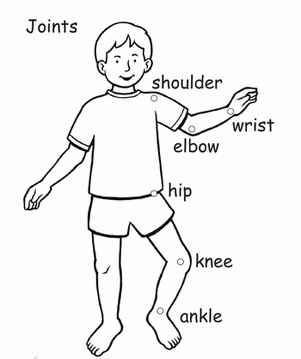
2. Joints - Joints are where two or more bones meet. At the joints, tendons attach muscles to the         bones. They allow us to bend.


3. Muscles - We have 600 muscles and they are elastic and flexible. We can move some of them (biceps), and other muscles move automatically (heart).


4. OUR CIRCULATORY SYSTEM
Our circulatory system carries nutrients and oxygen around the body. It is made up of the heart, the blood and the blood vessels.

1. The heart - It is a muscle the size of your fist and it´s in the middle of the chest. It works day and night to pump blood to every part of the body.

2. The blood - It is a red liquid that goes around the body. It travels in blood vessels.

3. The blood vessels - They are thin tubes through which the blood circulates.


5. OUR RESPIRATORY SYSTEM
When we breath in, oxygen enters our blood through the respiratory system.
When we breath out, the carbon dioxide leaves our body.
The respiratory system is made up of the nostrils, the windpipe, the bronchi and the lungs.

1. The nostrils - The nose has two holes called nostrils where the air enters our body.

2. The windpipe - It is a tube that carries air to the lungs.

3. Bronchi - Two tubes of the windpipe that carry the air to the lungs.

4. The lungs - They are two sacks made up lots of little sacks where the air goes in.

The process 
1. When we breath in, oxygen enters through the nostrils.
2. Next, it passes through the windpipe and goes down the bronchi into the lungs.
3. Then, the oxygen passes from the air into the blood and the carbon dioxide passes from the blood into the air.
4. Finally, the carbon dioxide leaves our body when we breath out.


6. OUR REPRODUCTIVE SYSTEM
Our reproductive system allows us to have babies.
Men and women have different reproductive systems.


Saturday, January 07, 2017

Social - Unit 3: Europe


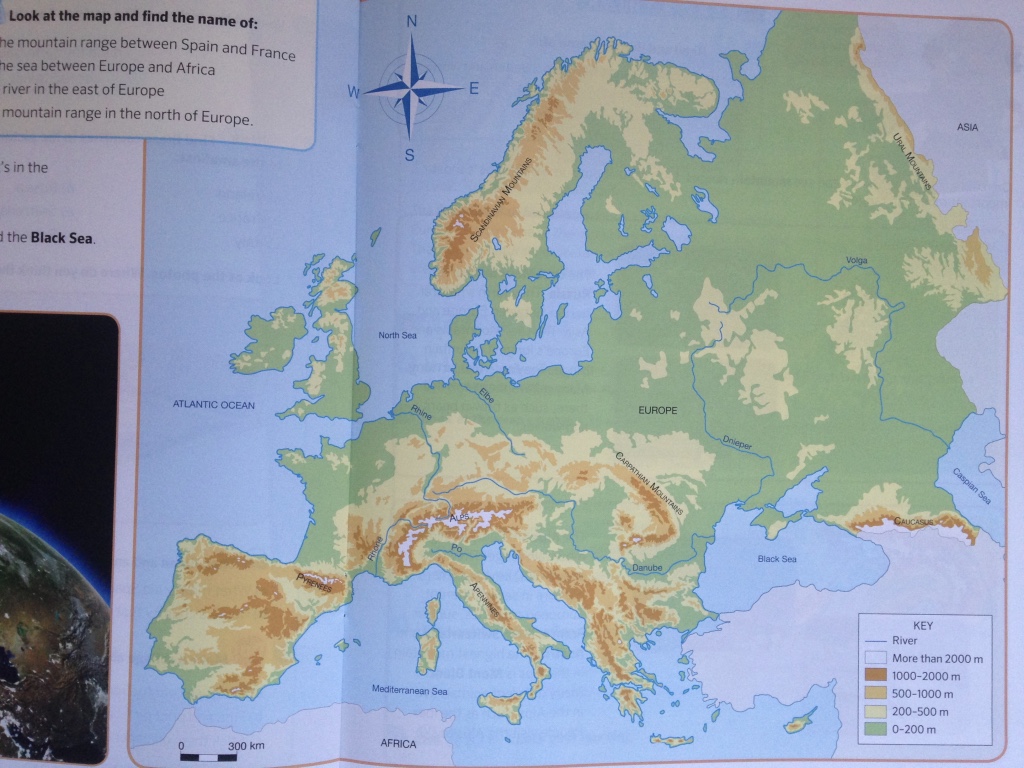
Europe is the second smallest continent in the world and it is in the Northern Hemisphere.
- to the north of Europe there is the Arctic Ocean
- to the south there is the Mediterranean Sea and the Black Sea
- to the west there is the Atlantic Ocean
- and to the east there is Asia

On relief maps of Europe we can see:


1. MOUNTAIN RANGES
    Europe´s most important mountain ranges are:

    - The Ural Mountains
      They are in Russia and they form a natural border between Europe and Asia.
      The Ural Mountains are Europe´s longest mountain range.
   - The Alps
     They are the highest mountain range in Europe.
     The Alps are in seven different European countries, such as France, Italy, Switzerland and                    Austria.
     The highest mountain in the Alps is Mont Blanc.
   - The Scandinavian Mountains
     They are on a peninsula in the north of Europe and form a natural border between Norway and            Sweden.
     They´re on of the oldest mountain ranges in the world.


2. RIVERS
    Europe´s most important rivers are:

   - The Volga
      It is in Russia and it´s the longest river in Europe. It flows into the Caspian Sea.
   - The Danube
      It is the second longest river in Europe and flows into the Black Sea.
   - The Rhine
      It starts in the Alps and it flows into the North Sea.


On political maps of Europe we can see many countries and cities. There are 47 different countries in Europe and each one has its own traditions and, many, their own language.


We are going to study some of them:


Try now some games... Game 1   Game 2   

Saturday, December 24, 2016

Natural - Unit 3: Plants

Plants are living things: they are born, grow, reproduce and die.
Plants need water, nutrients and minerals (from the soil), air and sunlight to live. They make their own food.
Plants can´t move around but they can move one or more of their parts.

Parts of a plant

All plants have roots, stems and leaves and these have different functions:

1. Roots - They fix the plant in the soil and get water from it.
2. Stem - It holds the plant up and the food pass through it to grow.
3. Leaves - The plant makes its food in them.


Plant reproduction

Some plants have flowers. Their reproductive organs are inside the flower.
Flowers have different parts:

The corolla is made of petals. Petals are different colours to attract insects.
The stamens are the male reproductive organs. They have pollen at the top.
The pistil is the female reproductive organ. It has ovules inside.
The calyx is made of sepals. Sepals are green and protect the flower.

The reproductive process or pollination process.

First, an insect takes pollen form a stamen to a pistil.
Then, inside the pistil, the pollen joins an ovule to make a seed.
Next, the petals fall off the flower and the pistil grows around the seed into a fruit.
Finally, the fruit falls on the ground and the seed grows into a new plant.


Plant nutrition

Process = Photosynthesis

First, roots absorb minerals and water from the soil.
Then, water and minerals pass through the stem to the leaves.
Next, leaves absorb sunlight and carbon dioxide from the air.
Finally, when plants make food, they make oxygen too to return it to the air. That´s good because animals need oxygen to live!

Photosynthesis = minerals + water + sunlight + carbon dioxide = food + oxygen


Types of plants

Tree
If a plant has a trunk, it is a tree. The branches on a tree grow high above the ground. Trees grow slowly.

Bush
If a plant has a woody stem, it is a bush. The branches on a bush grow near the ground.

Grass
If a plant has a flexible, green stem, it is a grass. Gasses are usually short and grow quickly.


We can also classify plants by their leaves:

- Evergreen - they always have leaves

- Deciduous - they lose their leaves in autumn and grow new leaves in spring.


In what ways do we use plants?

We use plants to:

- make clothes (we get thread from cotton plants)
- make furniture (we use wood from tree trunks)
- make paper and card (from wood)
- eat (we eat fruit and vegetables). We eat roots (ex. carrots), stems ex. asparagus), leaves (ex. lettuce) and flowers (ex. cauliflower)
- make flour (we use flour to make bread, pasta and biscuits)
- make perfumes, soap and cosmetics
- make some medicines


You can study doing these exercises...


Sunday, November 20, 2016

Our Christmas Carol

This year the Christmas Carol we are going to sing at school is...

RUDOLPH THE RED-NOSED REINDEER


Here you have the lyrics...


Karaoke version


Saturday, November 19, 2016

Natural - Unit 2: Animals


There are many different animals and we can divide them into two groups:
- vertebrates (Definition: Animals with spine. They have skeleton)
- invertebrates (Definition: Animals that don´t have spine neither skeleton)


VERTEBRATES

Animals with spine. They have skeleton inside them. Most of the have head, torso, limbs and tail.
We can classify them into five groups:

  • Mammals - They hace hair or fur. They breath with lungs and they usually have four legs. They are viviparous (Definition: They are born from their mother´s womb)
  • Amphibians - They have moist skin. When they are young they breath with gills, but later they have lungs. Adult amphibians have four legs. They are oviparous (Definition: They are born from eggs)
  • Fish - They live in water. They have scales and use fins to swim. They breath with gills. They are oviparous.
  • Birds - They are covered with feathers and they have two wings. They breath with lungs. They have two legs. They are oviparous.
  • Reptiles - They have dry, scaly skin. They breath with lungs. They are oviparous.

INVERTEBRATES

Animals without spine. They don´t have skeleton inside them. 
Invertebrate animals protect their bodies in different ways:
- some have a shell, such as snails and oysters.
- some have a exoskeleton: a thick exoskeleton, such as crabs and a thin exoskeleton, such as cockroaches
Let´s study three groups of invertebrates:
  • Molluscs - They have a soft, muscular body. Ex.: oysters, mussels, snails, octopuses.
  • Arthropods - Their body has three parts : head, thorax and abdomen. Many of them have antennae and some wings too. Arthropods with six legs are insects and with eight legs are spiders.
  • Worms - They have a long, soft body. Some worms are parasites (Definition: They live inside or on the skin of another animals and feed on them) Ex.: leeches and flatworms.


Animal Nutrition

Not all animals eat the same food. Depending on what they eat, animals can be:
  1. Herbivores - They only eat plants. Ex.: rabbits, pandas.
  2. Carnivores - They only eat other animals. Ex.: lynxes and spiders
  3. Omnivores - They eat plants and other animals. Ex.: bears and mussels


Animal Reproduction

Not all animals reproduce in the same way.
  1. Viviparous - They are born directly from their mother (from their mother´s womb). Ex.: sheep, kangaroos and seals.
  2. Oviparous - They are born from eggs. Ex.: birds, crocodiles and frogs.


You can study doing these exercises...